

The Scents of Shackleton's Antarctic Expedition
In January 2010, conservators from the New Zealand Antarctic Heritage Trust were on their knees in the crawlspace under a wooden hut at Cape Royds, on Ross Island, chipping ice away from a crate of Scotch whisky. They had first spotted the crates in 2006, while working to preserve the hut, locked in solid ice beneath the floor. Getting them out took another four years.
When the crate finally came free, they could hear the bottles moving inside it. Liquid. After a hundred and one Antarctic winters, the whisky had never frozen.
Three crates of Mackinlay's came up from under that hut, along with two of brandy. Eleven bottles survived intact, still wrapped in their original paper and straw, bottled in 1898 and left behind when Shackleton's Nimrod expedition sailed home in 1909.
Most of what survives from the heroic age of polar exploration reaches us with the smell taken out. Photographs are silent about it; diaries gesture at it. The whisky is the exception: an artifact you can still uncork, pour and put your nose into, which is exactly what happened to it a few months later in a laboratory in Scotland. It is the shortest route back into the sensory world those men lived in, and it is where our fragrance Erebus begins.

What does the name Erebus mean?
Erebus is the primordial Greek deity of darkness, born of Chaos in Hesiod's Theogony. The Royal Navy, which has never been shy about naming warships after the abyss, gave it to a bomb vessel: HMS Erebus. On 28 January 1841 her captain, James Clark Ross, sighted a smoking volcano at the bottom of the world and named the mountain after his ship.
Mount Erebus rises to just under 3,800 metres on Ross Island and remains the southernmost active volcano on Earth. Shackleton enters the story in March 1908, when a six-man party from his Nimrod expedition, led by the geologist Edgeworth David, climbed it: five days to the crater rim, on a mountain nobody had ever set foot on, in clothing you would hesitate to take up a Scottish hill in October.
So the name means darkness, and it belongs to the one thing at the bottom of the world that burns. The hut those climbers came back down to is the same hut with the whisky under the floor.
What was Shackleton's Endurance expedition?
The Endurance expedition of 1914 to 1917 was Shackleton's attempt to make the first land crossing of Antarctica, and it failed absolutely. The ship never reached the continent at all. What it produced instead is the most famous survival story of the age.
In August 1914, as Europe fell into the First World War, the three-masted barquentine Endurance left Plymouth carrying twenty-seven men besides Shackleton, sixty-nine sled dogs, and a tabby cat called Mrs. Chippy, who belonged to the carpenter Harry McNish and who was, despite the name, male. One of the twenty-seven, Perce Blackborow, was a stowaway found after departure and put to work as steward.
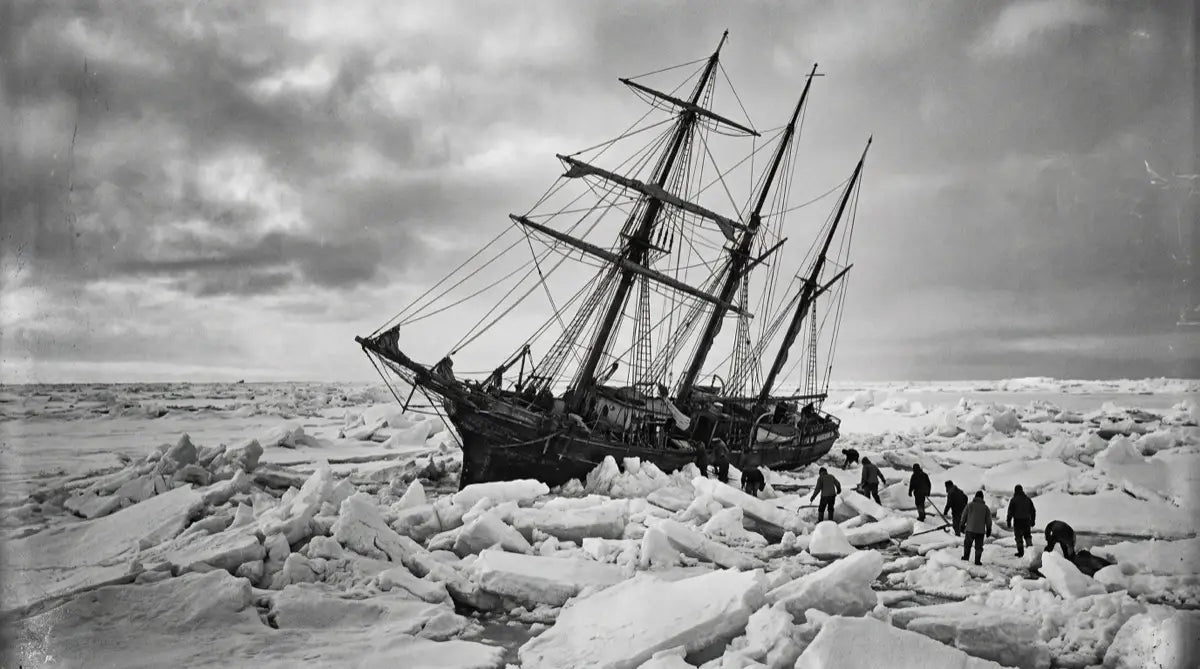
By January 1915 she was beset in the pack ice of the Weddell Sea. The crew lived aboard her for ten months, listening to the timber groan and crack under the pressure of the ice. On 27 October 1915 Shackleton gave the order to abandon ship. Roughly three and a half weeks later, with a cry of "She's going, boys!", the men watched Endurance lift her stern and slide under.
Then came the part that made the legend: five months camped on drifting floes, three lifeboats rowed through the most violent seas on the planet to uninhabited Elephant Island, and 800 miles of open ocean in a 23-foot boat, the James Caird, to South Georgia, where Shackleton, Frank Worsley and Tom Crean crossed the island's unmapped glacial interior in a single 36-hour push to reach a whaling station and organise rescue. All twenty-eight men came home alive.
The question this house cares about is what they were breathing while they did it.
What did Shackleton take to Antarctica?
Shackleton packed two kinds of cargo: calories, and reasons to stay sane. The first list is the one you would expect. Pemmican, sledging rations, tinned meat, dried vegetables, condensed milk and biscuit filled the hold, alongside reindeer-hide sleeping bags, Burberry gabardine sledging suits and Burberry-Durox boots, ankle-high leather boots with gabardine uppers reaching the knee.
The second list is the interesting one. A gramophone and records. Books enough for a small library. A banjo belonging to the meteorologist Leonard Hussey, and the banjo is where the whole manifest gives itself away: when the crew abandoned ship onto the ice, Shackleton limited every man to two pounds of personal possessions, then walked back for an instrument weighing twelve. "We must have that banjo," he said. "It's vital mental medicine."
Then the comforts that came in bottles and pouches: pipe tobacco, and whisky. For the Nimrod expedition of 1907 he had ordered twenty-five cases of "Rare Old Highland Malt" from Charles Mackinlay & Co., bottled at a stiff 47.3% ABV, a strength thought to have been chosen so the spirit would not freeze.
Everything on the second list was a bet on the same thing: that a man with something to look forward to at six in the evening is still useful at six in the morning. As for the strength of the whisky, the evidence spent the next century under the floorboards proving it right.

What did Antarctica smell like to Shackleton's crew?
Antarctica itself smells of almost nothing. Visitors describe an absence: air too cold and dry to carry much beyond a faint crispness and the briny edge of the sea. Whether the nose is genuinely defeated by the temperature or simply has nothing to work with, the experience people report is olfactory silence.
Shackleton's camps were not silent. Put twenty-eight men, sixty-nine dogs and a blubber stove in one place, subtract washing for several months, and the air fills up quickly.
Animal fat dominated everything. The men burned seal blubber for fuel, and the smoke was thick and greasy; Thomas Orde-Lees, the expedition's storekeeper and its most diligent diarist, recorded faces blackened with soot from the stoves. Boots waterlogged until each pair weighed some seven pounds. Reindeer sleeping bags that, once wet, never dried again.
Against that, the chosen scents did enormous work. The sweet curl of pipe smoke. The burn of whisky. Whatever the cook could conjure from a shrinking store of spice. "A slight variation in flavour now and again is a matter of far greater psychological importance than might at first appear," Orde-Lees wrote, and he meant it as a supply-management principle. The men seasoned their food with peppermint, ginger and citric acid raided from the medical chest, and Orde-Lees noted with approval the flavour that arrived when meat was cut on the same boards used for slicing tobacco.
That is a man recommending contamination as a condiment. Strip away enough, and a mouthful of whisky stops being a small pleasure and becomes the whole of the outside world.
What happened to Shackleton's whisky?
The recovered bottles went to Christchurch, then to Scotland, and finally back under the hut. Somewhere between those journeys, a master blender settled a question no tasting note had ever answered: what did a Victorian whisky actually taste like?
The thawing was done slowly at Canterbury Museum in Christchurch, ice removed by degrees so that the glass and the paper wrappings survived. Analysis dated the spirit to the Glen Mhor distillery in Inverness, distilled around 1896 to 1897 and bottled in 1898. Under a special New Zealand permit, three bottles were flown to Whyte & Mackay, who now own the Mackinlay's name, and handed to their master blender, Richard Paterson, known in the trade as "The Nose".
Paterson expected a Victorian heavyweight, dark and tarry, the sort of malt that arrives in the room before you do. What came out of the bottle was light and delicate: gently peated with Orkney peat, matured in American oak sherry casks, with apple, pear, marmalade and only a tease of smoke. A hundred and twelve years in a freezer, and the surprise was the elegance.
Paterson spent weeks reconstructing it. Mackinlay's "Shackleton" Rare Old Highland Malt was released in 2011 with a share of sales pledged to the Antarctic Heritage Trust; across two editions the donations reportedly approached four hundred thousand US dollars. In January 2013 the original bottles were flown south again and replaced beneath the floorboards of the hut at Cape Royds, where they remain.
That is the part we keep coming back to at Edenbridge. Not that the whisky was recovered, but that someone smelled it, wrote it down, and put it back.
What drove Shackleton to keep going back?
Four times Shackleton went to the Antarctic, three of them as leader, and he never once achieved what he set out to do. He never reached the Pole, never made the crossing. In January 1922, aboard the Quest at South Georgia and still heading south, he had a heart attack and died at forty-seven. He is buried there, at Grytviken.
His men called him "the Boss" and meant it kindly. On the boat journey to Elephant Island he gave his own mittens to the photographer Frank Hurley, who had lost his, and took frostbitten fingers in exchange. The leadership literature adds smaller stories in the same key: the Boss claiming the coldest spot in the tent, or rousing the entire camp for hot milk so that one struggling man could drink without being singled out. He picked his crew for temperament as much as skill, which is why applicants were asked whether they could sing. "Oh, I don't mean any Caruso stuff," he assured one startled candidate, "but I suppose you can shout a bit with the boys?"
The answer mattered. On Midwinter's Day, 22 June 1916, the men stranded on Elephant Island, sheltering under two upturned lifeboats with no idea whether Shackleton was alive, staged a concert. Twenty-four turns, Hussey on the banjo. Shackleton was not there to see the twelve pounds pay off. He had been right anyway.
He never explained the pull plainly. His record suggests a man who could not sit still in a warm room.
How did Shackleton's Antarctic expedition inspire the Erebus fragrance?
Erebus is our tribute to Shackleton and his crew, named for the volcano his men were the first to climb, and composed from the things they carried rather than the things they saw.
Tobacco leads, because pipe smoke was the scent men reached for through the polar night, the earthy sweetness that cut through blubber smoke and damp wool. Whisky sits beneath it, the Mackinlay's that went south in 1907 and came back up in 2010. Cinnamon carries the warmth of the galley and the spiced hoosh that kept men alive on the floes, while cedar does double duty: the packing crates, and the timber of the ship. Vanilla closes it, for the gramophone evenings around a stove before the ice closed in.

We make our fragrances in Kent, a long way from the Weddell Sea, and the Shackleton story is the clearest argument we know for the work: scent is close to the last possession that survives when everything else has been stripped away, and twenty-eight men proved it on a drifting floe with peppermint raided from a medical chest.
Erebus is part of our Portraits Sample Set, six artisan perfume samples inspired by history's most fascinating figures, so you can try the whole collection before committing to a bottle.
If you enjoy watching history and scent intertwine, you might also like The Real Story Behind Napoleon's Cologne and What Did Churchill Really Smell Like?
Frequently Asked Questions
What does the name Erebus mean?
Erebus is the primordial Greek deity of darkness, born of Chaos in Hesiod's Theogony. The Royal Navy gave the name to HMS Erebus, and in 1841 Captain James Clark Ross named a smoking Antarctic volcano — Mount Erebus, the southernmost active volcano on Earth — after his ship. A party from Shackleton's Nimrod expedition made the first ascent of the volcano in 1908.
What was Shackleton's Endurance expedition?
The Endurance expedition (1914–1917) was Ernest Shackleton's attempt to make the first land crossing of Antarctica. The ship was crushed by pack ice in the Weddell Sea before reaching the continent, and the crew survived five months on drifting ice floes, an open-boat journey to Elephant Island, and an 800-mile voyage to South Georgia. All twenty-eight men survived.
What did Shackleton take to Antarctica?
Alongside pemmican, sledging rations, tinned food, reindeer-hide sleeping bags and Burberry gabardine clothing, Shackleton packed for morale: a gramophone, a library of books, Leonard Hussey's banjo — which Shackleton called 'vital mental medicine' — pipe tobacco, and Mackinlay's whisky bottled at 47.3% ABV.
What happened to Shackleton's whisky?
Three crates of Mackinlay's whisky, bottled in 1898 and abandoned by Shackleton's Nimrod expedition, were recovered from beneath his Cape Royds hut in January 2010 by the New Zealand Antarctic Heritage Trust. Eleven bottles survived intact. Whyte & Mackay analysed the whisky — surprisingly light and delicate — recreated it as a limited edition, and the original bottles were returned beneath the hut in 2013.
What did Antarctica smell like to Shackleton's crew?
Antarctica itself smells of almost nothing — the air is too cold and dry to carry scent. Shackleton's camps were another matter: greasy blubber-stove smoke, damp wool, waterlogged leather boots and wet reindeer-hide sleeping bags, cut through by the chosen comforts of pipe tobacco and whisky.

Leave a comment
This site is protected by hCaptcha and the hCaptcha Privacy Policy and Terms of Service apply.