

Did Churchill Really Wear German Cologne Every Day?
December 1934. In a narrow shop at 89 Jermyn Street, under Spanish mahogany cabinets acquired from the Great Exhibition, a Floris clerk writes out a receipt. One bottle of Special No. 127. One bottle of Stephanotis. The customer's name, entered at the top in the shop's careful hand: Winston Churchill.
He was sixty that winter, and about as far from Downing Street as a former Chancellor could fall. Five years out of office, at odds with his own party, warning about German rearmament to a House that suspected his motives more than it feared his facts, and writing at a furious pace to fund Chartwell, the Kent house, and the life he ran there. A man in that position still needs to smell like somebody. So he went to Jermyn Street.
That receipt hangs in the Floris shop today, framed behind glass, and it is the only piece of paper in the whole story of Churchill and cologne. Everything else — the German bottle by his mirror, the Creed made specially for him, the Penhaligon's he supposedly favoured — is legend, and every legend in this article gets measured against that one slip of paper.

What Cologne Did Winston Churchill Actually Wear?
The only fragrance Churchill is documented wearing is Floris Special No. 127, a British citrus cologne, and the December 1934 receipt at 89 Jermyn Street is the proof. The International Churchill Society, which has no cologne to sell, calls Floris "the perfumery that supplied Churchill with his standard fragrance Special Number 127". Floris itself is happy to agree, describing No. 127 as "a complex and refined fragrance, much like Churchill himself" — a shop will forgive a good customer almost anything.
Three other bottles trail after his name. The best known is 4711 Echt Kölnisch Wasser, the German eau de cologne he is said to have splashed on every morning; that story gets the full treatment below. Penhaligon's Blenheim Bouquet has a real family pedigree — commissioned in 1902 by the 9th Duke of Marlborough, Winston's cousin, and named for the palace where Winston was born — but whether Winston himself ever wore it is retailer lore, and Penhaligon's own copy is careful not to say so. And Creed Tabarome, long sold as the tobacco-laced cologne Creed built for the cigar-smoking Prime Minister, gets the axe: no independent record exists, fragrance historians have doubted Creed's celebrity provenances for years, and Creed's own current page for Tabarome no longer mentions Churchill at all. When we looked at what Churchill really smelled like, we let Creed get away with the story. We're not letting them get away with it as history.

What Is Floris Special No. 127?
Floris Special No. 127 is a citrus aromatic created in 1890 for Russia's Prince Orloff, and it takes its odd name from a page number. Commissioned as a private blend — orange, bergamot, lavender and petitgrain over a floral heart of geranium, neroli, rose and ylang-ylang, with patchouli and musk underneath — it was recorded in the house's "Specials" formula book, and when it later joined the public range it was named after the page the recipe sat on. Page 127.
The shop that sold it to Churchill is nearly unchanged. Floris has traded at 89 Jermyn Street since 1730, is still run by the same family, and remains a long-standing royal warrant holder. Special No. 127 is still on the shelves, as an Eau de Toilette and an Eau de Parfum, and on the wall hangs Churchill's unpaid-for immortality: a routine December purchase, kept because no shop throws away a receipt with that name at the top. It is quiet, verifiable, and English. Which brings us to the loud, unverifiable, German version of events.

Did Churchill Really Wear German Cologne?
Nobody can prove it — no biographer, archive or National Trust source records Churchill using 4711 — but the story is everywhere, so here it is at full strength.
A bottle of 4711 Echt Kölnisch Wasser stands on the washstand at Chartwell. Each morning, after working in bed through his boxes, the man who will face down Nazi Germany rises, bathes in water drawn by his manservant at exactly 98 degrees, and splashes on a cologne from Cologne: turquoise-and-gold label, the same splash favoured by German grandmothers from Aachen to Königsberg. He does this every day of his life. The National Trust shop at Chartwell has sold 4711 as a Churchill favourite, shelved near his Pol Roger, and fragrance blogs on every continent now repeat the daily ritual as settled fact.
Except nobody can put the bottle in his hand. Follow the story backwards and it does not lead to a diary, a valet's memoir or a Chartwell inventory. The most solid citation anyone can produce is a single line in a 2019 Forbes travel piece noting that the Chartwell shop sells 4711 and Pol Roger as "Churchill favorites". The shop cites the legend; the legend cites the shop. Gift shops are in the business of selling things. Footnotes are another department.
To be fair to the legend, nothing about it is out of character. Churchill drank Pol Roger, which is French, and smoked Romeo y Julieta cigars, which are Cuban; he would not have cared where a good cologne came from. By his day, in any case, 4711 had stopped reading as German in any pointed sense — asking a man of his generation why he wore Cologne water would be like asking someone today why they drink French wine.
The habit fits the body it's attached to, too. Churchill kept the same routine for decades: bed-work through the morning, the pre-lunch bath, an hour's nap, a second bath before dinner. It was so well known that the Nazis mocked it — as the Churchill historian Richard Langworth records, the party's picture weekly Illustrierter Beobachter ran a cartoon of his bathing in June 1941. "Churchill was a famous bather—twice a day when he had time," Langworth writes. A light citrus splash you can reapply after every bath suits a man like that far better than a heavy parfum. As advocacy for the legend goes, that is the best anyone can do.
So the case stands like this. On one side, a plausible habit, a gift-shop shelf, and ten thousand blog posts citing each other. On the other, a framed receipt. We file the German cologne under good stories until Chartwell's records say otherwise — and note that the fragrance we can actually place in Churchill's hands came from Jermyn Street, not Glockengasse.

None of which is 4711's fault. The cologne itself is real, venerable, and wrapped in legends of its very own.
What Is 4711 Cologne?
4711 Echt Kölnisch Wasser is a German eau de cologne made in the city of Cologne since 1792, named after a house number, and still in production today. Its founding story, fittingly for this article, comes in two versions.
The version the company long told: in 1792, a young Cologne businessman named Wilhelm Mülhens receives a wedding gift from a Carthusian monk — the secret recipe for an aqua mirabilis, a miracle water. Sold as a medicinal tonic, it is drunk, rubbed on temples, and sworn by.
The tonic part is true. The monk is not; researchers at the University of Cologne treat him as brand mythology, and 4711's own website tells the founding tale with and without him depending on which page you read. The duller record is that Mülhens paid an unrelated man named Farina for the use of his surname — trading on the fame of Cologne's original perfume house — and lost the right to it after decades of litigation. In 1881, out of names, the firm rebranded around the number on its front door.
The number, at least, is honestly come by. In 1794, as French revolutionary troops occupied Cologne, the city's houses were numbered consecutively to organise the billeting of soldiers, and the Mülhens house on Glockengasse drew 4711. The image of a French officer chalking the digits on the façade is later advertising, and the address itself lasted only until Cologne renumbered its streets in 1811. The number outlived the system that created it, then the building: the firm's grand nineteenth-century headquarters was destroyed by bombing in 1943, and the "House of Fragrances" you can visit on Glockengasse today is a 1963 rebuild in the old neo-Gothic style.

The liquid has outlasted everything. Seven constants — lemon, orange, bergamot, lavender, rosemary, petitgrain and neroli — in a bright, weightless blend designed to be splashed on liberally and reapplied through the day. Procter & Gamble sold the brand to Mäurer & Wirtz, a family firm from Stolberg in the Rhineland, in a deal completed in 2007, and the blue and gold label has barely changed in two centuries. It is one of the world's oldest fragrances still in continuous production. It is not, despite the frequent claim, the oldest eau de cologne. Thereby hangs the last question.

Why Is It Called Eau de Cologne?
"Eau de Cologne" means "water from Cologne", after the German city where the Italian perfumer Giovanni Maria Farina created the original light citrus fragrance in 1709 — and Farina's house is still there, still making it, which is why 4711 can never honestly claim the "oldest" title. For a century the city's makers sold their citrus waters as medicine as much as scent.
Napoleon, of all people, ended that. His decree of 1810 required the recipes of internal medicines to be made public, and rather than reveal their formulas, Cologne's miracle-water makers — Mülhens among them — reclassified their products as external fragrances. The whole trade turned from medicine to scent by paperwork. Napoleon was himself a prodigious customer of the stuff, as we found when we investigated the real story behind Napoleon's cologne; he regulated an industry he was personally keeping in business.

What Does Churchill's Cologne Teach Anyone Choosing a Fragrance?
Take even the generous version of the story and Churchill wore a system: a fresh citrus for the daily round, a more complex fragrance from Jermyn Street when the day called for it. Most people are still best served that way — something light for every day, something warmer for evenings and cold months, perhaps one bottle that means something. His documented choice adds a second lesson: he found a shop that had already been trading for two centuries, picked one thing, and stayed loyal to it. In 1934, with his career in ruins, he was still buying the same cologne from the same counter.
A good story beats a true one everywhere except on paper. Paper is what history is made of, and Churchill's says Floris.
But no cologne, English or German, is what Chartwell actually smelled like. That was leather armchairs and dark panelling, a glass of Scotch on the side table, cigar smoke drifting in from the garden, cedarwood and old books and the warmth of rum and cinnamon somewhere underneath.
That is the world we tried to bottle.
Chartwell by Edenbridge — A Fragrance Inspired by Churchill's Kent
We're a small, family-run fragrance house here in Kent, a few miles down the road from the real Chartwell. When we created our Chartwell fragrance, we didn't try to reconstruct what Churchill wore — you've just read how little of that survives scrutiny. We tried to capture what he came home to: a light spice opening that settles into cedarwood, incense and leather, the smell of a wingback Chesterfield, a pour of Scotch in an old library, cigars with coffee on a bright morning.
If Churchill's cologne was about freshness and routine, Chartwell is about the room at the end of the day.
Inspired by the leather armchairs, Scotch, and cigar smoke of Churchill's Kent home.
Shop Chartwell →Cedarwood, incense, leather, rum & cinnamon. From £34.99.
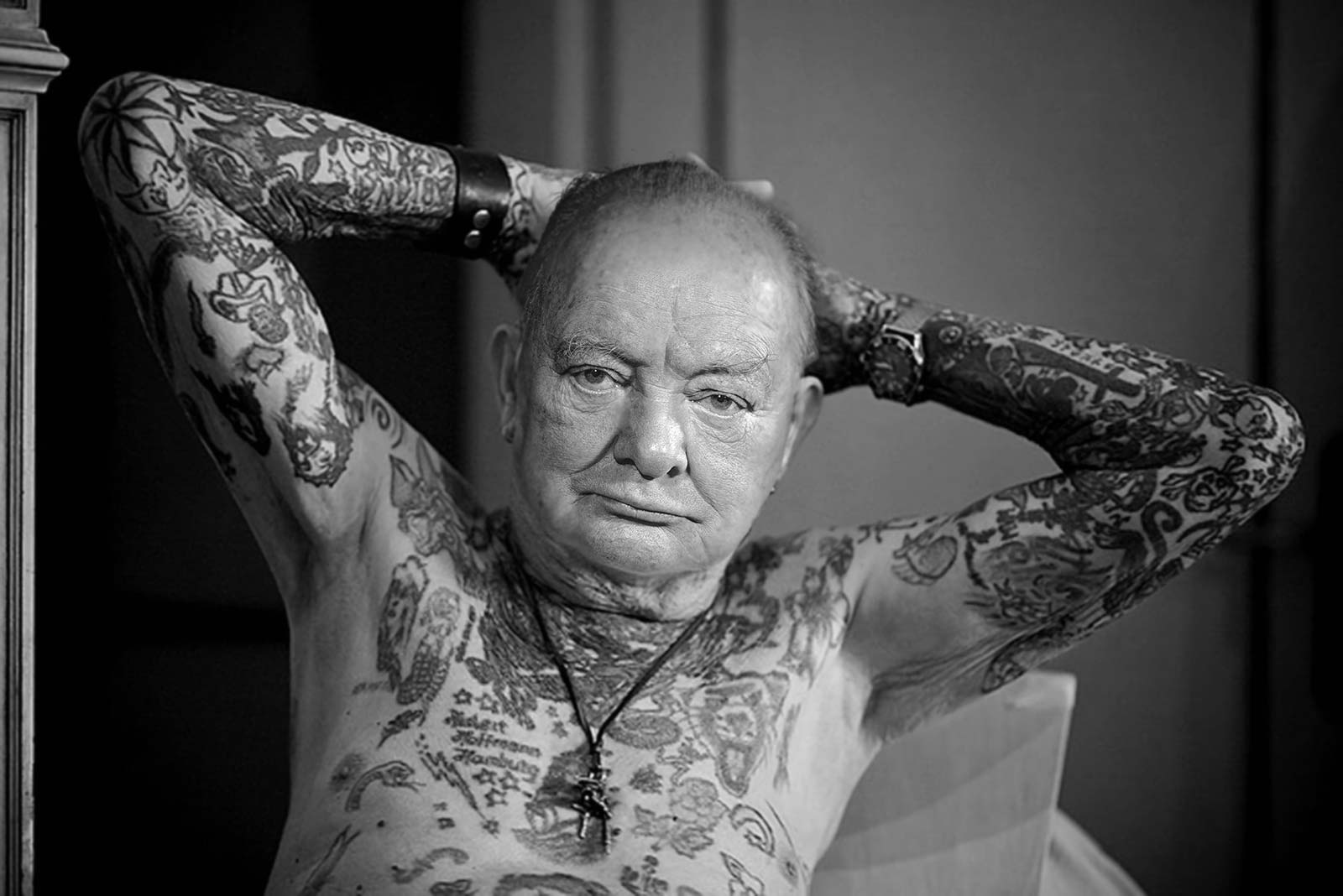
Chartwell is also part of our Portraits Collection discovery set — six artisan perfume samples inspired by figures from history. And if you enjoyed watching a legend meet a receipt, try the case of Churchill's secret tattoo, another story the man's own skin declines to corroborate.
Frequently Asked Questions
What cologne did Winston Churchill wear?
The only fragrance Churchill is documented wearing is Floris Special No. 127, a British citrus aromatic created in 1890; a December 1934 receipt made out to Churchill is displayed at the Floris shop in London. He is also widely said to have used German 4711 eau de cologne daily, though that claim is not confirmed by any biographer or archive. Penhaligon's Blenheim Bouquet and Creed Tabarome are associated with him mainly through marketing.
Did Churchill really wear German cologne?
Possibly, but it is not proven. The story that Churchill used 4711 Echt Kölnisch Wasser every day is widely repeated, and the National Trust shop at Chartwell has sold 4711 as a Churchill favourite. However, no biographer or National Trust source confirms the habit. His one documented fragrance purchase was British: Floris Special No. 127.
What is 4711 cologne?
4711 Echt Kölnisch Wasser is a German eau de cologne made in Cologne since 1792 and named after the house number assigned to the Mülhens family premises on Glockengasse in 1794. It is a fresh citrus blend of lemon, orange, bergamot, lavender, rosemary, petitgrain and neroli, and one of the world's oldest fragrances still in continuous production. It is made today by Mäurer & Wirtz.
What is Floris Special No. 127?
Floris Special No. 127 is a citrus aromatic fragrance created in 1890 for Russia's Prince Orloff and later named after its page in the Floris formula book. Churchill bought and wore it; his 1934 receipt is displayed at the Floris shop at 89 Jermyn Street, London. It is still sold today.
Why is it called eau de cologne?
"Eau de Cologne" means "water from Cologne", after the German city where Italian perfumer Giovanni Maria Farina created the original light citrus fragrance in 1709. When Napoleon decreed in 1810 that the recipes of internal medicines must be made public, Cologne's makers of scented "miracle waters" reclassified their products as fragrances rather than reveal their formulas, cementing cologne's place as a fragrance category.


Leave a comment
This site is protected by hCaptcha and the hCaptcha Privacy Policy and Terms of Service apply.