

The History of Cologne: How One City's Water Changed the World
In 1803, a Cologne businessman named Wilhelm Mülhens paid a stranger from Bonn for something that could not be distilled, bottled or grown. He bought a surname.
The seller was a man called Farina, and the surname was his sole qualification. He had no share in the famous perfume house of that name, no drop of its water. What he had was a signature Mülhens could put on a label — and Mülhens had been putting it there since 1799 anyway. The contract simply made the theft look tidy.
A fragrance cannot be locked in a safe. The formula walks out of the workshop in the nose of every apprentice, and any competent distiller with a bergamot supplier can come close enough to fool a customer. So from the moment eau de cologne became worth money, the fight was never really about the liquid. It was about what you were allowed to call it — a two-hundred-year argument over six letters, settled in the end by four digits.

Where did cologne actually come from? The eau de cologne origin story
Eau de Cologne was created in Cologne, Germany, in the early 18th century by Italian emigrants from the Alpine valleys of Piedmont, and which of them deserves the credit has been argued over, in print and in court, for the better part of three hundred years.
The Italian version starts with Giovanni Paolo Feminis, who left Valle Vigezzo near the Swiss border in the late 1600s and set up a distillery on the Rhine. Among his products was an Aqua Mirabilis, a miracle water of alcohol and plant essences sold chiefly as medicine. People dabbed it on the skin, breathed it off a handkerchief, and drank it; in an age with no germ theory and very little pharmacology, a great deal of medicine consisted of drinking something pleasant and hoping. Feminis's home town still keeps a museum in his honour and holds him up as the true father of eau de cologne.
The Farina family are less charmed. Their house history does not mention Feminis at all, and the family has dismissed the connection as gossip. What the records show is that Giovanni Maria Farina, possibly a distant relative from the same valley, reached Cologne around 1706.
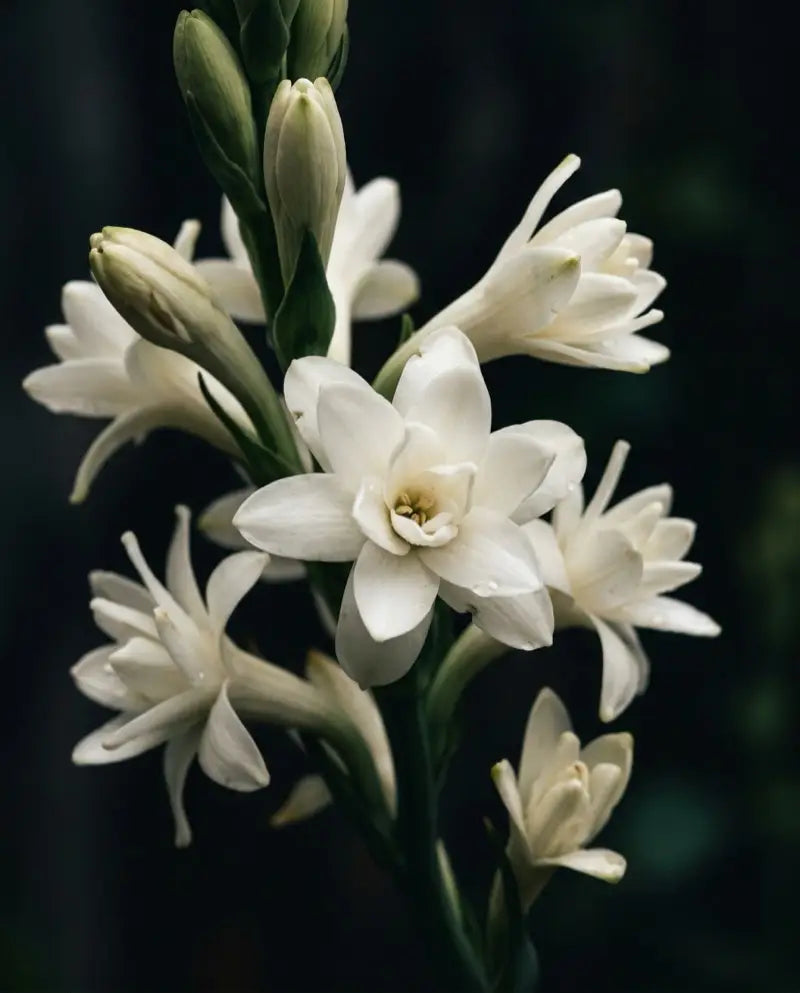
Two years later he sat down to describe what he had made to his brother, and reached for a memory instead of a formula. "I have found a fragrance that reminds me of an Italian spring morning," he wrote, "of mountain daffodils and orange blossoms after the rain." It is the only description of the original that survives in the maker's own words, and it names two flowers rather than a recipe. On 13 July 1709 his elder brother founded the family firm, trading at first in luxury goods; Giovanni Maria turned it into a perfumery. That same July, the city granted him citizenship.
Then he made the decision that mattered. He could have called the water after himself, as every perfumer in Europe did. Instead he named it Eau de Cologne — water of Cologne, after the city that had just made him a citizen — and wrote the label in French, the language of commerce and court life. He had given his best product a name that belonged to a place, and a place cannot sign a contract in Bonn.
What made Farina's water worth stealing?
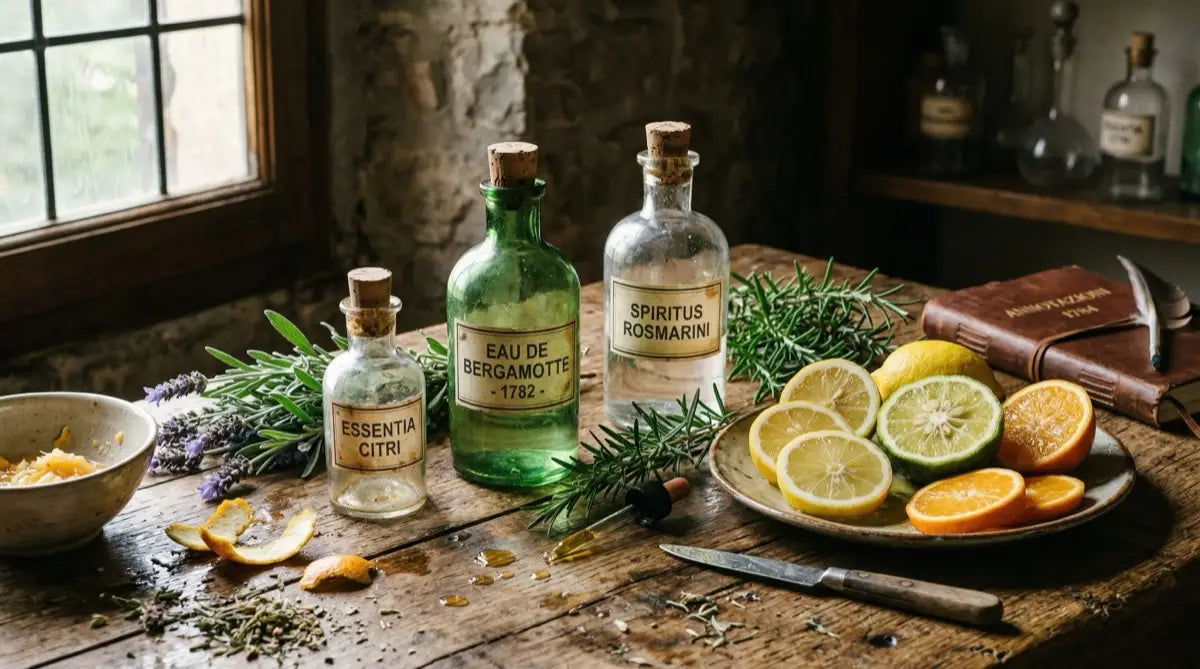
It was light, and nothing else on the market was. The dominant perfumes of early 18th-century Europe were thick animalic constructions of musk, ambergris and civet, dosed to overpower in an era when even the rich bathed rarely. Farina's water went the other way: bergamot, lemon, orange and neroli, lifted with rosemary and lavender, in an alcohol base that faded off the skin within a couple of hours. It smelled of the outdoors. The exact formula has never been published; the family have kept it for eight generations and show no sign of tiring of the exercise.

The innovation was economic as well as aesthetic. The German Patent and Trade Mark Office, which profiles Farina among its "brands with history", notes that bright citrus did the work of ruinously expensive musk. A perfumer could now make something exquisite out of fruit — and Farina's genius was to notice that his customers, who were nominally buying medicine, were really buying the smell.
Europe's palaces fell on it. The surviving order books read like a court circular: Frederick the Great and Voltaire both buying from 1745, Queen Victoria ordering 600 bottles in her coronation year of 1837. Goethe called it "this sweet-smelling vice", which is the sound of a man who has tried to give something up more than once. The first documented shipment to Paris left Cologne in 1727, and the Seven Years' War turned an export into a phenomenon, French officers stationed on the Rhine carrying bottles home in their kit.
Which is when the copying began. Success on that scale, in a trade with no registrable brands and no enforceable recipes, had exactly one consequence: by one German trade historian's count, 39 separate firms in Cologne alone eventually traded under the name "Jean Marie Farina". Walk the right streets and every second shopfront promised you the original. At least the Paris Jean-Marie Farina was a genuine relation — a great-grandnephew who opened there in 1806, and whose business was later bought by Roger & Gallet.
Thirty-nine competitors, one name, no law worth the paper. The most successful impostor of all was not even among them yet.
Who invented 4711 — and what's the real 4711 history?
4711 was created by the Mülhens family of Cologne, whose business dates itself to 1792, and it is not the original eau de cologne — that distinction belongs to Farina, whose firm predates it by eighty-three years.
The company's founding story is the best thing about it, which is usually a warning sign. On 8 October 1792, the day of Wilhelm Mülhens's wedding, a Carthusian monk is said to have pressed into the groom's hands a recipe for an Aqua Mirabilis — a dynasty in a wedding envelope.
The monk in the story is surnamed Farina.
No independent record supports the tale. What the archives show is Mülhens selling cologne water from 1799 under the name "Franz Maria Farina", and then, four years later, that contract with the stranger from Bonn. He was not stealing a formula. He was stealing a reputation, and unlike a formula, a reputation had to be bought retail.
How did a house number become a brand?
Because a number was the one asset the courts could not take away. The Farina family spent decades in litigation, and they won, over and over. Mülhens lost in 1832, lost again in 1833, and kept losing; at one point the firm recruited an unrelated Farina from Mortara in Lombardy as a partner, purely to keep a living Farina on the letterhead. It ended in 1881, when a Cologne appeal court compelled Wilhelm's grandson Ferdinand to strike "Farina" from the company name for good.
Which left him with an address.
The number comes with a myth of its own, encouraged for a century by 4711's advertising: a French officer on horseback riding down the Glockengasse with a brush and a pot of paint, daubing numbers on doors, stopping at the Mülhens house to paint 4711. It is a wonderful image. It is also an advertisement.
Cologne's own city council voted to number every building on 3 October 1794, three days before French revolutionary troops entered the city. The occupiers kept the scheme and used it for billeting and conscription — a number on your door meant soldiers in your parlour and your sons on a list. The Mülhens house drew 4711. The cathedral, still unfinished, drew 2583½. The city abandoned the system in 1811, by which time the number was already on the bottles.
So in 1881 Ferdinand Mülhens rebranded around the four digits, which the firm had registered as a trademark in 1875, the first year German law allowed anyone to register one. (The often-repeated claim of a trademark dating to 1845 cannot be true; there was no trademark law to register under.) A surname could be bought, faked and fought over by thirty-nine competitors. A house number assigned by a clerk had no rival claimant anywhere on earth.
It worked. 4711 has been on shelves for over two centuries, its citrus, lavender, rosemary and neroli picking up admirers as unlikely as Winston Churchill, whose enthusiasm for a German cologne during a war with Germany we've traced in our article on Churchill's German cologne. Meanwhile the house that won every lawsuit never moved. Farina still makes fragrance at Obenmarspforten 21 in Cologne, under the eighth generation of the family, recognised by the German Patent and Trade Mark Office as the world's oldest perfume factory still in existence.
Two firms, one name — and the loser got the famous brand.
What role did Napoleon play in the history of cologne?
Napoleon bought eau de cologne in industrial quantities, and then changed the law under which it was sold. According to The Perfume Society, drawing on the accounts of the Paris perfumer Chardin, he kept a standing order of 50 bottles a month; his valet Constant put it nearer sixty. A quarterly bill from 1806 lists 162 bottles of cologne at 423 francs, together with 26 pots of almond paste and 20 sponges. Bottles were small then, and eau de cologne is the lightest category there is, so the figure is less absurd than it sounds. Only slightly.
Constant left a description of what the sponges were for. Napoleon bathed long and hot, and when he stepped out he wanted the cologne — citrus-led, with rosemary, lavender and thyme — poured over his head and shoulders while he was rubbed down, still talking, already dictating. The rosemary, it's often said, carried him back to Corsica, where the herb grows wild over the cliffs. Tradition also has him eating sugar lumps soaked in cologne, a scented version of the French canard, the cube dunked in coffee or brandy. No contemporary document records the sugar lumps, which has never stopped anyone repeating them.
The decree is better attested, and mattered far more. On 18 August 1810 Napoleon ordered makers of secret remedies to disclose their formulas to the state. Eau de cologne had been sold as medicine for a century, so its producers faced a straight choice: surrender the recipe, or stop calling the product a cure. Almost all of them kept the recipe and gave up the medicine. Cologne was reclassified as perfumery, sold by perfumers rather than apothecaries, and the fragrance category we know today came into being as a side effect of a law about quack cures. The Paris Farina house reportedly did file its formula, and went on advertising therapeutic benefits for years. We go into his habits, bills and bathing routine at greater length in the real story behind Napoleon's cologne.
An emperor could compel a perfumer to reveal his formula. He could not stop the man next door from calling himself Farina.
Cologne vs perfume: what's the actual difference?
The difference is concentration, not gender. Eau de Cologne carries roughly 2-5% aromatic oils in an alcohol base, which makes it bright, fresh and short-lived — perhaps two hours on the skin. Eau de Toilette sits around 5-15%, Eau de Parfum at 15-20%, and pure Parfum at 20-30%. The bands are industry convention rather than law, and houses interpret them freely, but the ladder holds as a rule of thumb.
Farina's original was never gendered; kings and queens wore the same water. The association of "cologne" with men's fragrance is largely a 20th-century American marketing convention, which makes it the last and least deserved of the naming disputes in this story. In Europe, cologne has always meant a strength.
A name is the only thing you can own
Farina named his water after a city and kept it for eight generations. Mülhens bought a surname, lost it in court, and built one of the most recognisable brands in Europe out of the number a clerk assigned to his front door in 1794. Napoleon's decree still governs which shelf the bottle sits on. Not one of those outcomes turned on the liquid in the bottle.
We name things for a living too, which is why the story appeals to us. Our own Corsica is named for an island rather than a founder, and takes the citrus and rosemary of Napoleon's beloved eau de cologne into modern wear, swapping his thyme for brighter basil and grounding it in leather and cedarwood — a tribute to the man who turned a morning wash into a statement of power.

If you'd like to smell the rest of the history, our Portraits Sample Set lets you try the full collection of historically inspired fragrances.

Leave a comment
This site is protected by hCaptcha and the hCaptcha Privacy Policy and Terms of Service apply.