

Article: What Did the Tudors Smell Like? A Guide to Tudor Perfume
What Did the Tudors Smell Like? A Guide to Tudor Perfume
A small ball of boxwood, turned on a lathe and drilled all over with holes. It went to the bottom of the sea in 1545 with Henry VIII's flagship, and came up again four centuries later with a plaited silk cord still attached, knotted to a leather scabbard. It sits now in the Mary Rose Museum in Portsmouth, catalogued as object 81A4395. The Mary Rose Trust believes it belonged to one of the ship's archers.
Not a courtier or a physician. A working soldier, who went to war with dried herbs and spices hanging at his hip.
Almost everything written about Tudor perfume runs upwards — towards the throne, into the wardrobe accounts, out of the mouths of ambassadors. This one runs the other way. It belonged to a man on a gun deck, in air thick with tar, bilge and three hundred other bodies, and he had tied it where he could get at it in a hurry. Nobody in England knew how disease travelled, but everybody could smell where it seemed to come from, and so scent was medicine long before it was luxury. The archer and the queen were doing the same thing. She just had better materials.

What Did the Tudors Actually Smell Like?
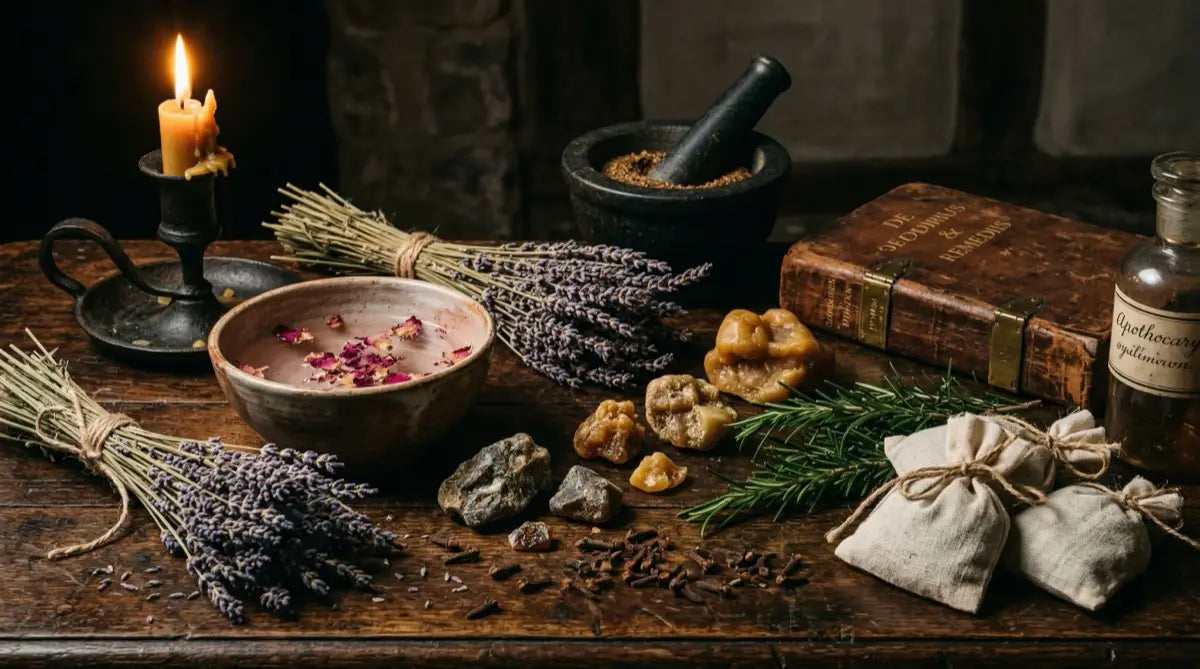
At street level, England smelled of woodsmoke, animals, open drains and whatever the tanners were doing that week. Hides were cured in urine and dog faeces on the edge of every town. The defence was cheap and green: lavender laid into linen presses, and rosemary, thyme and meadowsweet strewn across floors so that every footstep bruised them into scent. The herbalist John Gerard, writing in 1597, claimed that "Queene Elizabeth of famous memory did more desire" meadowsweet "than any other herb to strew her chambers withall."
Gerard was selling a herbal, and he had just put the Queen's taste in it. The difference between him and the printers who come later in this story is that he published while Elizabeth was alive and in a position to be annoyed. A queen and a farmer's wife could agree on meadowsweet. That was about where the agreement ended.
What Was Tudor Perfume Made Of?
Tudor perfume proper was built on three imported animal materials: ambergris, a waxy substance from the digestive tract of sperm whales; musk, from the gland of the musk deer; and civet, scraped from the glands of the civet cat. None of them were subtle. Raw, they sit closer to the farmyard than the flower bed, and they reached England through Italian merchants at prices that put them beyond nearly everyone.
Rosewater, benzoin resin, lavender and spices such as cloves and cinnamon softened the blend. Blended well, it unfolded on warm skin over hours instead of evaporating in twenty minutes — the same trick a good artisan perfume is still pulling, with the whales left out of it. That is the wardrobe of the very rich. The archer's boxwood ball was the same idea, scaled down to what a man could afford.
What Is a Pomander, and Why Did Nearly Everyone Carry One?
A pomander was a small perforated case worn on the body, packed with a scented paste and designed to leak. The name comes from the French pomme d'ambre, "apple of amber," and at the top of the market they were feats of goldsmithing: a silver example in the V&A opens like an orange into six hinged segments, each compartment engraved with the scent it was meant to hold. Ambergris in one, musk in another, rosewater, cloves. You hung it from a neck-chain or a girdle, and as you moved, it worked.

The best pomander story of the century belongs to Cardinal Wolsey, and it is told everywhere. Wolsey, so it goes, invented the poor man's pomander — an orange stuck all over with cloves — and carried one through the crush of petitioners who followed him about Westminster, which is why the clove-studded orange still turns up in Christmas craft books five hundred years later.
Except his gentleman usher was standing right there. George Cavendish, who watched Wolsey daily and wrote his life, describes something stranger and better. The Cardinal moved through the crowds "holding in his hand a very fair orange" whose flesh had been scooped out and replaced with a sponge soaked in vinegar, held to his nose "against the pestilent airs." No cloves. No cinnamon. A great man of the Church walking through his own petitioners with a hollowed fruit full of vinegar clamped to his face, like smelling salts.
Clove oranges did exist as household plague charms, so anyone who has made one at Christmas is closer to Tudor medicine than to Wolsey. And that word "pestilent" is the whole fashion in a nutshell. Pomanders were not popular because Tudors were vain. They were popular because Tudors were frightened.
Could a Sweet Smell Really Keep the Plague Away?
They believed it could, and the reasoning was airtight as long as you got the premise wrong. Plague came back to London again and again through the sixteenth century, and with no notion of how infection moved, physicians worked from the miasma theory: disease travelled in bad air, and bad air announced itself by its stench. Every visitation seemed to confirm it, because the districts that stank worst tended to bury the most people. If corruption smelled foul, sweetness must be its opposite, and a nose full of ambergris was a nose the sickness could not get past.
So the pomander was medical equipment. Holding a scented ball to your face in a plague street was the Tudor version of pulling on a mask, and it came with an armoury of companions: sponges soaked in rose vinegar, nosegays bought at the door, handkerchiefs dabbed with lavender water. Elizabeth I reportedly travelled the Thames with a pan of burning herbs and oils going on her barge. The beaked leather mask everybody now pictures when they hear the word "plague" belonged to the next century; its first known image is a 1656 engraving of a Roman plague doctor. The Tudor version was a piece of fruit, or a jewel on a chain, or a fistful of rosemary.
None of it worked. What it did instead was fix an idea in place for generations — that a good smell was healthful and even morally sound, while a bad one meant rot and danger. Which meant a man who smelled expensive was not merely showing off. He was making a claim about himself, and everyone around him could read it.
What Perfume Did Henry VIII Wear?
No fragrance can be put on Henry VIII's person with any confidence, which will disappoint the many websites that print his recipe. The recipe is genuine enough. A household manual called A Closet for Ladies and Gentlewomen carries a formula headed "King Henry the eight his perfume": compound water, rosewater, fine sugar, and a few grains each of musk, ambergris and civet, boiled softly together until "all the house will smell of Cloues."
It was printed in 1608. Henry VIII had been dead for sixty-one years.
He was not wearing it in any case. You boil that mixture in a pot to scent a room; nobody was putting it on the king. The Folger Shakespeare Library, which has written about the recipe, reads royal-named formulas of this kind as an early form of celebrity-fragrance marketing — a dead Tudor's name on the label to shift copies of a stillroom book. The perfume trade did not invent the borrowed monarch in the twentieth century.
What the paper trail does support is spending. Henry's Great Wardrobe, the department that clothed and furnished him, laid out real money on scented goods, and the biographer Alison Weir writes that his clothes were perfumed with lavender and orange-flower water. Perfumed gloves were the court's signature luxury, for a plain commercial reason: tanned leather keeps the memory of how it was tanned, and washing the skins in rosewater or orange-blossom water was the only way to bury it. Glove-making and perfumery were barely separate trades. On New Year's Day 1540 the Italian military engineer Archangelo Arcano gave the king a pair of perfumed gloves, and the royal apothecary Cuthbert Blackeden scented gloves for Henry's daughter Mary.
All of it belonged to a bigger Tudor policy: magnificence, deliberately deployed. When Henry met Francis I at the Field of the Cloth of Gold in June 1520, among the cloth-of-gold pavilions and the fountains running with wine, the surviving accounts dwell on spiced food and drink rather than perfume. The perfume gets added later, by people who want the story lusher than it was. Overwhelm the senses and you have made an argument about power without saying anything — and the archer with his boxwood ball was running the cheapest possible version of the same instinct.
How Did Elizabeth I Use Perfume at Court?
Elizabeth wore scent on her gloves, her garments and her underclothes, and the receipts survive. Her wardrobe accounts for 1579 record "a pair of bodies of sweete lether" — a perfumed leather bodice, worn next to the skin. In 1564 her wardrobe page John Wynyard was issued a steel perfuming pan for scenting her clothes: a man with a hot pan, working through the queen's linen, which is the least glamorous object ever to stand behind a Gloriana portrait. Both come from Janet Arnold's reconstruction of the royal wardrobe, and both are worth more than any amount of "her favourite notes were rose and amber" — a claim with no Tudor source under it.
Her household was also nervous about scent, for good reason. In the early 1560s her chief advisor William Cecil drew up cautions warning that "no manner of perfume, either in apparel or sleeves, gloves, or such like" should reach the queen from any stranger. A scented gift sat against the skin for hours, which made it a delivery system as well as a compliment. Later writers embroidered that anxiety into legend, casting Catherine de' Medici's perfumer René as a man equally expert in scent and murder; no contemporary evidence has him poisoning anybody. The fear is the find. Perfume got you physically close to a monarch, and Cecil policed it accordingly.
The gloves that did get through came from Italy. Stow's chronicle records that when Edward de Vere, Earl of Oxford, returned in 1576 he brought Elizabeth perfumed gloves, sweet bags and a perfumed leather jerkin, and the scent became known at court as the Earl of Oxford's perfume. The Florentine house Santa Maria Novella likes to trace those gloves to its own Acqua della Regina. No document connects the two. That chain is brand legend, and a fine one, still doing commercial work in Florence today.
And then her name went the way her father's had. A recipe printed as "Queen Elizabeths Perfume," built on sweet marjoram and benzoin, appears in a seventeenth-century book — after her death, with her authority attached and her permission nowhere in sight. Both Tudors ended up as fragrance brands.
What Has Tudor Perfume to Do With Kent?
Rather a lot, from where we are sitting. Hever Castle, where Anne Boleyn grew up, is about three miles from Edenbridge.
Anne left Hever in 1513 for the court of Margaret of Austria, then spent seven years in France, which put her inside the best perfumery in Europe during the years she was learning how to be looked at. She came home with a continental polish that undid Henry. Hilary Mantel gives her one line in Wolf Hall — "Her skin is faintly perfumed: amber, rose" — a novelist's invention rather than a source, and still the best-known description of how a Tudor woman smelled. Local tradition even holds that Henry used Bolebroke, a hunting lodge just over the Sussex border, as a base while he courted her, riding through the lanes we drive to work.
We know the position we argue from. We are a fragrance house that names bottles after people out of the history books, and if we are going to be hard on a printer in 1608 we had better be hard on ourselves. The difference is small and, we think, the whole thing: we do not claim the dead wore our work. We read the wardrobe accounts, say which parts are ledger and which are legend, and then make something we would put our own name to.
A nameless archer tied a drilled ball of boxwood to his scabbard, and it outlasted the ship, the king and the dynasty. He was doing what Elizabeth was doing in her perfumed bodice, on a budget of nothing. The Tudors reached for scent the way you reach for a seatbelt. We get to reach for it the way you choose a record.
If you want to know how we turn history into fragrance, our Historia Sample Set and Portraits Sample Set are six-sample introductions to the collections. And for another ruler who took his scent extremely seriously, read the real story behind Napoleon's cologne.
Frequently Asked Questions
What was Tudor perfume made of?
Tudor perfume was built on three animal ingredients — ambergris from sperm whales, musk from the musk deer, and civet from the civet cat — softened with rosewater, lavender, benzoin resin and spices such as cloves and cinnamon. All three animal materials were imported and extremely expensive; cheaper households relied on lavender, rosemary and strewing herbs instead.
How did Tudor pomanders work?
A pomander was a small perforated case, often silver or gold and opening into segments like an orange, packed with a scented paste of ambergris, musk, civet and spices. Worn on a chain or girdle, it released scent through its piercings as the wearer moved. The name comes from the French pomme d'ambre, meaning "apple of amber". A boxwood pomander was even recovered from Henry VIII's warship the Mary Rose, tied to an archer's scabbard.
Did the Tudors believe sweet smells could ward off the plague?
Yes. Under the miasma theory, disease was thought to travel in foul-smelling "bad air", so Tudors carried pomanders, nosegays, rose-vinegar sponges and lavender-scented handkerchiefs as protection against plague. It didn't work, but it made fragrance a matter of health as much as luxury.
What perfume did Henry VIII wear?
No verified personal fragrance of Henry VIII survives. A recipe titled "King Henry the eight his perfume" — rosewater, sugar, musk, ambergris and civet — was printed in A Closet for Ladies and Gentlewomen in 1608, sixty-one years after his death, and is a room perfume rather than a body scent. His court's documented scent spending centred on perfumed gloves and scented garments.
How did Elizabeth I use perfume?
Elizabeth I's wardrobe accounts record a perfumed leather bodice (1579) and a steel perfuming pan issued in 1564 for scenting her clothes. She favoured meadowsweet as a strewing herb according to the herbalist John Gerard, and received celebrated perfumed gloves from the Earl of Oxford in 1576. Her advisor William Cecil warned that no perfumed gifts from strangers should reach her, for fear of poison.

Leave a comment
This site is protected by hCaptcha and the hCaptcha Privacy Policy and Terms of Service apply.